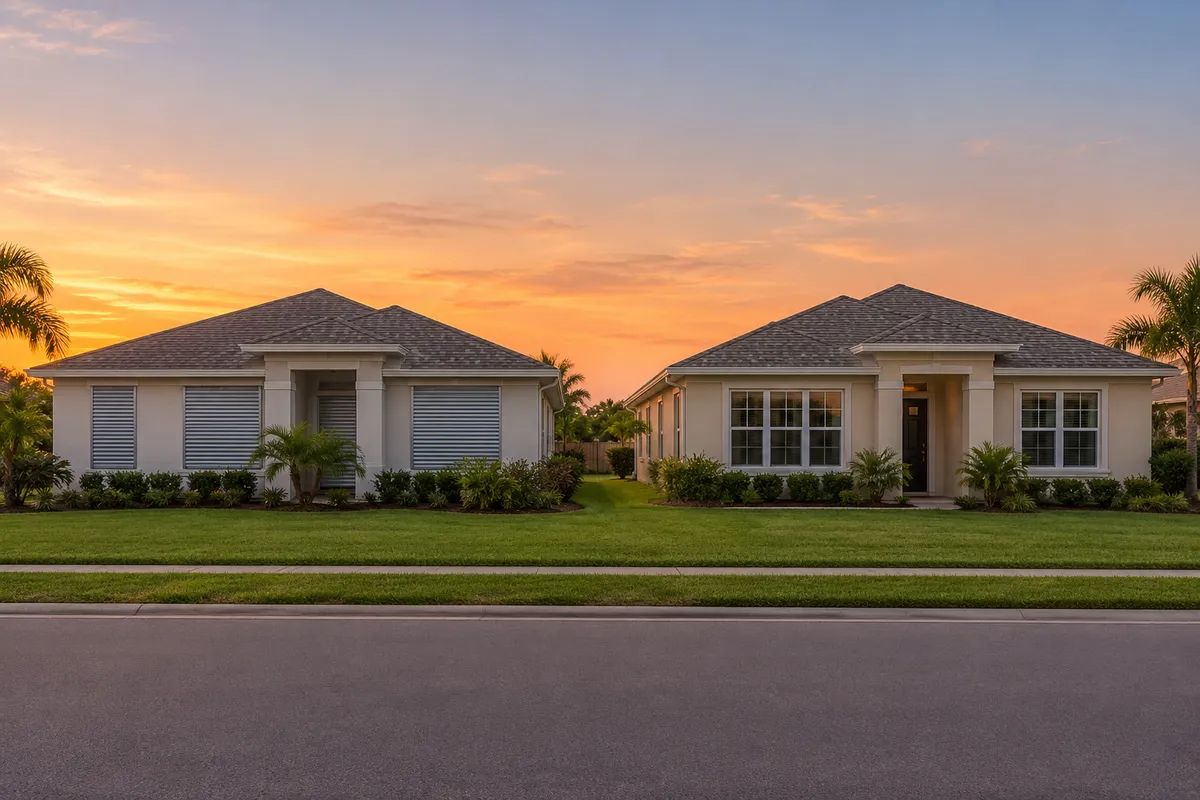
Bay County Hurricane Protection Rules by Year Built
Whether a Bay County home has hurricane protection depends less on the neighborhood than on the date its building permit was issued. Florida's rules for covering windows and doors against flying debris changed in 2002 and again in 2007, and each change decided what a builder had to install.
That matters here because Bay County built heavily during the years the Panhandle had its own, weaker rule. Census Bureau permit records show 16,134 new housing structures authorized in the county from 2003 through 2006 alone, counting multi-family buildings.
Brannan Aluminum is based in Panama City Beach, so this is a question our neighbors ask. This guide explains each rule change in plain terms, how to tell which one applies to your home, and what the rules do and do not tell you about the shutters, impact windows or panels you may or may not have.
Quick answer
Does my Bay County home have hurricane protection?
Not necessarily. For Panhandle homes permitted from March 2002 until 2007, the code required protection from flying debris only within one mile of the Gulf. Homes permitted after mid-2007 follow the statewide wind map. Find your permit date, then check your windows and doors for shutters, impact-rated glass or stored panels.
Why does the year your home was built decide what protection it has?
Florida requires new homes in a wind-borne debris region to protect their glass openings from flying debris. The region is a map-based area set by the Florida Building Code, and both the map and the rules behind it have changed. Protection can be impact-rated glazing, or shutters and panels approved under Florida's product approval system.
The code edition that applies to a house is generally the one in force when its permit application was filed, and Charlotte County's notice about the 8th Edition describes the rule in those terms. The permit date is therefore the date that counts, and it can differ from the year a home was finished. Confirm with your own building department which date it used for your address.
Permit date | What the code required for new Panhandle homes | What that means for your home |
|---|---|---|
Before March 1, 2002 | No statewide code. Each local government enforced its own. | The rules depended on the local code in force at the time. |
March 1, 2002 to early 2007 | Statewide code with the Panhandle exception. Debris protection was required only within one mile of the Gulf coast, and builders could design for internal pressure instead of covering openings. | A home more than a mile from the Gulf was not required to have opening protection. A home inside the strip could meet code without it. |
Early 2007 to December 30, 2023 | Exception phased out during 2007, then the internal-pressure option removed. After mid-2007 the debris region follows the wind map. | For homes permitted after mid-2007, opening protection was required wherever the debris region covered the lot. Early-2007 permits fall in the transition. |
December 31, 2023 onward (8th Edition) | The first version of the 8th Edition dropped the word "coastal" from the debris-region definition, which would have added areas beside large inland lakes and bays. A 2024 amendment restored it. | No change for lake and bay lots under the current text. This could change in a later edition (see below). |
What was the Panhandle exception, and which homes did it affect?
The one-mile limit was set by the Florida Legislature in 2000, under pressure from Panhandle homebuilders, according to an Insurance Journal report. When the first statewide Florida Building Code took effect on March 1, 2002, it carried that limit forward. In the stretch of coast from Franklin County west to Escambia County, which includes Bay County, the wind-borne debris region covered only land within one mile of the Gulf. A 2006 report by the Connecticut Office of Legislative Research states the consequence: new buildings outside that one-mile strip did not have to meet the debris-protection standards, regardless of wind speed.
A second option also existed. Inside a debris region, a builder could skip window protection by designing the structure to withstand higher internal pressure instead. The Florida Building Commission's report to the 2008 Legislature records that the 2007 Legislature required the Commission to eliminate the exceptions and that option.
In practice, a home permitted between March 2002 and early 2007 that sits more than a mile from the Gulf was not required to have opening protection. A home inside the one-mile strip had to protect its openings or use the internal-pressure alternative. None of this says a particular home lacks protection, because owners and builders could add it voluntarily. It says the code did not require it.
Bay County's building boom fell inside that window. Census Bureau permit counts show 1,616 new housing structures authorized in 2002, then 3,676 in 2003, 3,844 in 2004, 5,538 in 2005 and 3,076 in 2006. The four full years from 2003 through 2006 add up to 16,134. The counts include multi-family buildings and are not split by distance from the Gulf, so they cannot tell you how many single-family homes lacked protection. They do show how much of the county's housing was permitted while the exception applied.
What changed in 2006 and 2007?
In 2006 the Commission recommended that the Legislature remove the Panhandle debris-region definition from state law, which would let the Commission set the region itself. In 2007 the Legislature then required the Commission to eliminate the exceptions. The result put the Panhandle on the same footing as the rest of the state: land within one mile of the coast where the basic wind speed is 110 mph or more, plus any land where it is 120 mph or more.
The Commission's report to the 2008 Legislature gives both June 1 and July 1, 2007 as the legislative deadline, so confirm the cutoff with the building department if your permit falls near that date.
What about the 8th Edition and the 9th Edition?
The 8th Edition of the Florida Building Code took effect on December 31, 2023. Its first version removed the word "coastal" from the debris-region definition, which would have extended protection to buildings within a mile of large inland lakes and bays in areas with design wind speeds of 130 to 140 mph. According to the Florida Roofing and Sheet Metal Contractors Association, a 2024 Annual Technical Amendment put the word back, so that expansion is not being enforced.
That may not last. The same association reports two proposals for the 9th Edition that would strike "coastal" again, and the Commission's April 2026 Phase II interim report shows the inland question is still under study. The 9th Edition is scheduled to take effect on December 31, 2026. We have not reviewed what it adopts, so check with your building department if you are permitting new work after that date.
How do I find out which hurricane protection rules my Bay County home was built under?
To find out which rules apply to your home, work through these steps in order.
Find the permit date. Ask the Bay County or city building department for the permit file for your address. The permit application date matters more than the year the home was finished.
Match the date to the table above. The row it falls in tells you what the code required of the builder.
Ask about the debris region. For a home permitted after mid-2007, ask whether the lot was inside the wind-borne debris region under the code edition on the permit.
Look at the house. Check for shutter tracks or hardware around the windows, impact-rated glass, and stored shutters or panels.
What does this guide not settle?
The exact 2007 cutoff. The Commission's report gives both June 1 and July 1, 2007 as the final legislative deadline. For a permit between early and mid-2007, the building department has the answer.
Whether your lot is in the debris region today. That depends on the wind map. We have not mapped individual neighborhoods.
Whether work on your home triggers current rules. This guide describes what new construction had to meet. It does not say whether a re-roof, an addition or a window replacement requires protection now.
How many homes lack protection. The permit counts include multi-family buildings and are not split by distance from the Gulf.
What the 9th Edition changes. It is scheduled to take effect on December 31, 2026 and we have not reviewed it.
What should you do this weekend?
Get the permit date for your address.
Walk around the house and note which openings have protection and which do not.
If a gap shows up, ask a licensed installer which approved systems fit your openings, and ask for the Florida Product Approval number of each.
A home with unprotected openings has a decision still to make, and the calm weeks before a storm watch are the time to make it.
Sources
Florida Building Commission. Report and Recommendations to the 2008 Florida Legislature. February 2008. floridabuilding.org
Florida Building Commission. Panhandle Wind Borne Debris Region decision materials. June 2006. floridabuilding.org
Connecticut Office of Legislative Research. Shutter Protection for Buildings in the Florida Building Code (2006-R-0645). 2006. cga.ct.gov
Insurance Journal. Insurance, Other Groups Call for Elimination of Panhandle Carve-Out. June 19, 2006. insurancejournal.com
U.S. Census Bureau, via FRED. New Private Housing Structures Authorized by Building Permits for Bay County, FL (BPPRIV012005). fred.stlouisfed.org
Florida Building Commission. Investigation of the Wind-borne Debris Regions in ASCE 7-22, Interim Report. December 15, 2024. floridabuilding.org
Florida Building Commission. Investigation of the Wind-borne Debris Regions in ASCE 7-22, Phase II Interim Report. April 2026. floridabuilding.org
Florida Building Commission. Facilitator's Summary Report. April 16, 2024. floridabuilding.org
Silvers, Mike. Where is the Windborne Debris Region? Why Does it Matter? Is it Going to Change?. Florida Roofing and Sheet Metal Contractors Association. September 2025. floridaroof.com
Charlotte County Community Development. New 8th Edition of the Florida Building Code, Effective on December 31, 2023. charlottecountyfl.gov
