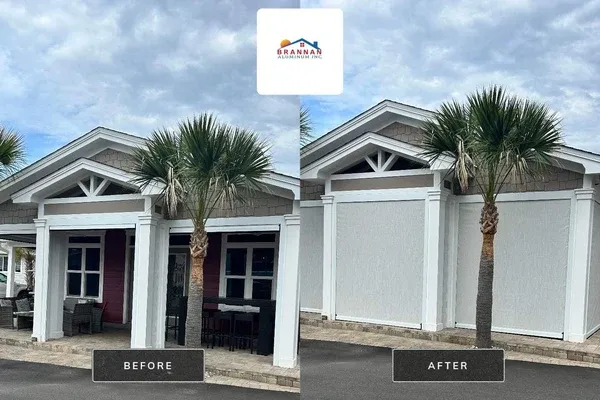
Hurricane Screen or Insect Screen? How to Choose the Right Motorized Screen for Your Panhandle Home
A hurricane screen and an insect screen solve different problems. An insect screen is an everyday screen for normal weather: it keeps bugs out, lets the breeze in, and should be raised when strong wind is coming. Fine no-see-um mesh stops the biting midges that regular screen lets through. A hurricane screen does everyday jobs too, but it is also built and approved to protect the opening in a storm. Fenetex hurricane screens carry Florida Product Approval FL8637, tested to the TAS 201, 202 and 203 standards and approved for use both inside and outside the high-velocity hurricane zone, so they can stay down when a storm arrives. If your worry is the lanai in a hurricane, start with a hurricane screen. If it is no-see-ums at dusk, start with a fine-mesh insect screen. If it is afternoon sun, a shade screen does the job. Neither one stops flooding or storm surge.
On October 9, Hurricane Isaias came ashore near Destin as a Category 2 storm with 105 mph winds. Roads flooded in Destin, debris covered streets in Pensacola, and more than 700,000 customers in Florida and Alabama were without power the next morning. If you spent that Friday dragging patio furniture inside and wondering what the wind would do to your lanai, you weren't alone.
Here's the thing many homeowners realized that week. Even if your house has impact windows, your lanai doesn't. It's an open-air room, and it's usually where you spend the most time: coffee in the morning, dinner outside, the grandkids in the pool.
Most days, of course, the problem isn't a hurricane. It's the no-see-ums at dusk, the sun blasting the west side by 4 o'clock, or a summer storm blowing rain onto the cushions. Motorized screens can handle all of it with one button. But there are two very different kinds, and choosing the right one starts with what's actually bothering you.
Two kinds of motorized screens
Everyday screens are built for comfort. They come in insect mesh (including a fine weave for no-see-ums), shade fabric that cuts the afternoon sun, and clear vinyl that blocks rain and chilly wind while keeping the view. They roll down from a slim housing when you want them and disappear when you don't. They're designed for normal weather, so you raise them when strong wind is on the way.
Hurricane screens do everyday jobs too: they give shade and daytime privacy, and Fenetex dealers say the fabric blocks about 91% of UV. But they're also built and tested to protect the opening in a storm. Fenetex hurricane screens carry Florida Product Approval FL8637, tested to the TAS 201, 202 and 203 standards and approved for use both inside and outside the high-velocity hurricane zone, so they can stay down when a storm arrives.
Start with your worry
If two or three of these sound familiar, you're not unusual. That's where it pays to think about where you live.
Where you live changes the answer
On the coast: Panama City Beach, 30A, Destin, Navarre and Gulf Breeze
This is hurricane country. Isaias hit this stretch this month, and Michael devastated Bay County in 2018. If you have a lanai or covered patio facing the Gulf or a bay, a hurricane screen is usually the first thing to look at. It protects the space you can't board up, and on ordinary days it still gives you shade. If you're often away during storm season, being able to close it from your phone matters too.
In Pensacola and Perdido Key
Pensacola has a long memory for storms. Sally in 2020 dropped 20 to 30 inches of rain on the Pensacola area and gusted to 86 mph at the naval air station, according to the Florida Department of Environmental Protection, and Isaias left debris across its streets this month. Homes near the water here have the same case for hurricane screens as the beaches to the east.
Near marshes and bayous, and farther inland
If you live near salt marsh or along a bayou, the everyday enemy is the no-see-um. According to the University of Florida, several coastal biting midges breed in marshes, swamps and mangroves, and many species fly relatively long distances, up to about 2 kilometers, or more than a mile. Regular screens don't stop them; only fine no-see-um mesh does, so an insect screen with that mesh is usually the first priority, with a hurricane screen for homes right on the water.
Farther inland, UF notes that many biting midges breed in water-filled tree holes, and those trees are much more common in the Panhandle's hardwood forests. For most inland homes, an insect or shade screen does the most good day to day.
When you want both
Plenty of homeowners end up wanting both: a hurricane screen on the big Gulf-facing opening, and insect or shade screens on the rest of the lanai. Some systems can pair two screens on the same opening. Fenetex's Florida approval drawings show a secondary non-hurricane screen paired with the primary hurricane screen, such as fine insect mesh for everyday evenings with the hurricane screen ready for storm season. Ask your installer what's possible for your openings.
What a screen won't do
It won't stop flooding. If your home faces storm surge, a screen protects against wind and debris, not rising water.
An everyday screen isn't storm protection. Insect, shade and clear screens should be raised when strong wind is coming.
"Hurricane-rated" isn't an official label. Cincinnati Insurance notes that building codes recognize wind and impact ratings, not a "hurricane rating." Ask for the Florida product approval number and what standards the screen was tested to.
Questions to ask before you choose
Is this screen hurricane-approved? What is its Florida product approval number?
For everyday screens, at what wind speed should I raise them?
What happens if the power is out when a storm is coming? Is there a manual or backup option?
Can I control the screens from my phone when I'm away?
What does the warranty cover for the fabric, the motor and the installation? Each is often different.
Who handles the permit and HOA approval?
Could a hurricane screen help my wind mitigation insurance credit? (On the state's form, the opening credits require every glass opening to be protected. Ask your agent.)
Brannan Aluminum has helped Panhandle homeowners protect and enjoy their outdoor spaces since 1992. We install Fenetex motorized screens, including MaxForce hurricane screens and One-Track everyday screens, so we can help you choose one, the other or both, based on your lanai, where you live and what you're actually trying to solve.
Frequently asked questions
What's the difference between a hurricane screen and an insect screen?
An insect screen is an everyday screen that keeps bugs out and lets the breeze in, and it should be raised in strong wind. A hurricane screen does everyday jobs too, but it's built, tested and approved to protect the opening in a storm.
Do I need hurricane screens if I already have impact windows?
Impact windows protect the glass in your walls, but a lanai or covered patio is an open-air space they don't cover. A hurricane screen protects that space and the furniture and doors inside it.
Do motorized screens keep out no-see-ums?
Only if they use fine no-see-um mesh. Regular screen openings are large enough for biting midges to pass through. Ask for the finer insect mesh if you live near marsh or water.
Can an insect screen stay down during a hurricane?
No. Everyday insect, shade and clear screens should be raised when strong wind is coming. Only hurricane-approved screens are designed to stay down in a storm.
Can I have a hurricane screen and an insect screen on the same opening?
Some systems allow it. Fenetex's Florida approval drawings show a secondary non-hurricane screen paired with the primary hurricane screen, so ask your installer what works for your openings.
What happens to motorized screens if the power goes out?
Motorized screens run on electricity, and how a given system behaves in an outage depends on the model. Ask for the manual-override or backup-power details in writing before you buy, especially if you plan to close them ahead of a storm.
Sources
Associated Press via WBUR. Hundreds of thousands without power after Isaias slams the Florida Panhandle and Alabama. October 10, 2026. wbur.org
FOX 13. Hurricane Isaias updates: DeSantis addresses widespread power outages after landfall. October 10, 2026. fox13news.com
Florida Department of Environmental Protection. Hurricane Sally post-storm beach conditions and coastal impact report. November 2020. floridadep.gov
University of Florida IFAS. Biting midges, no-see-ums, Culicoides spp. (IN626). read October 2026. edis.ifas.ufl.edu
Florida Building Commission. Product Evaluation Report, FL8637 Fenetex Hurricane Screens (revision R15). April 9, 2026. floridabuilding.org
Florida Building Commission. Installation drawings, FL8637 Fenetex Hurricane Screens (revision R14). 2023. floridabuilding.org
Eastern Metal Supply. Transform your outdoor space with Fenetex motorized screens (dealer release). read October 2026. easternmetal.com
Cincinnati Insurance. 3 myths about hurricane wind protection. May 4, 2021. blog.cinfin.com
My Safe Florida Home. Understanding opening protection ratings on the Uniform Mitigation Verification Inspection Form 1802. modified March 9, 2026. support.mysafeflhome.com
Brannan Aluminum. MaxForce hurricane screens. read October 2026. brannanaluminum.com
Brannan Aluminum. Shade and insect screens. read October 2026. brannanaluminum.com
