How Much Do Hurricane Shutters Cost in Northwest Florida? A 2026 Guide for Local Families
Brannan's 2026 installed prices for hurricane shutters range from $16 to $115 per square foot, depending on the type. For a standard 3-by-5-foot window (15 square feet), that works out to about $240 for fabric shutters at the low end and up to about $1,725 for Bahama or colonial shutters at the high end. Fabric shutters cost the least. Storm panels and accordion shutters sit in the middle, motorized roll-downs come next, and Bahama and colonial shutters cost the most. Your exact price depends on how many openings you protect and how big they are, so treat these as a starting point. The better question to start with is who in your house can actually close them when a storm is two days out.
You know how it goes. On Tuesday it's a tropical storm way out in the Gulf. By Thursday morning it has a name, a category and a cone pointed at the Panhandle. The plywood at the hardware store is gone by noon, the ladder is in the garage, and someone in your house has to spend Friday climbing up to the second-floor windows with a drill.
Isaias came ashore near Destin on October 9 as a Category 2 storm with 105 mph winds, and more than 700,000 customers in Florida and Alabama were without power the next morning. If you did that dance again this month, you've probably wondered what permanent shutters would cost and which kind fits your household. This guide covers the six types we install, what each costs in 2026, how each one closes, and what they can do for your insurance.
What hurricane shutters cost in 2026
Shutter type | Per square foot | One standard 3x5 ft window | How you close it |
|---|---|---|---|
Fabric shutters | $16 – $24 | $240 – $360 | Attach the fabric panel to its mounting hardware and fasten |
Storm panels (aluminum or clear polycarbonate) | $24 – $30 | $360 – $450 | Carry out, lift into tracks, fasten |
Accordion | $50 – $60 | $750 – $900 | Slide closed by hand and lock |
Motorized roll-down | $85 – $95 | $1,275 – $1,425 | Press a button or use your phone |
Bahama | $104 – $115 | $1,560 – $1,725 | Lower the awning-style panel and secure |
Colonial | $104 – $115 | $1,560 – $1,725 | Swing both sides closed and latch |
Brannan's 2026 price ranges, based on a standard 3-by-5-foot window (15 square feet). Large sliders, picture windows and second-story openings can change the price, and your exact number comes from measuring your home.
For a whole house, the total depends on how many openings you protect. As an example, ten standard 3-by-5-foot windows add up to 150 square feet. At these rates, that's about $3,600 to $4,500 with storm panels, $7,500 to $9,000 with accordion shutters, $12,750 to $14,250 with motorized roll-downs, and $15,600 to $17,250 with Bahama or colonial shutters. Sliding doors and larger windows add to that.
Start with a different question: who's closing them?
Every type here protects your home when it's rated and installed correctly. So the better question isn't which one is "best." It's which one the people in your house can actually close with a storm a day or two out. Is someone often traveling? Is there a parent at home who shouldn't be on a ladder? How many windows are upstairs? Your answers point to the right shutter faster than any spec sheet.
The six types, matched to the families they fit
Fabric shutters: for families who want light and easy storage
Heavy-duty fabric panels that attach over each opening before a storm and roll up for storage afterward. They're light, they take up little space in the garage, and they cost the least of any type here. Someone still has to put them up, so they suit households where most openings are easy to reach.
Storm panels: for families who don't mind a little work
Aluminum or clear polycarbonate panels you store in the garage and fasten over each window before a storm. Clear panels let light in while they're up. They take more time and muscle to put up than permanent shutters, so they're a good fit if you're handy and most of your windows are on the ground floor.
Accordion shutters: for families who want it quick and simple
These stay mounted beside each window, fold out like an accordion and lock in the middle. There's nothing to store and no tools to find, and closing them is much quicker than hanging panels. A popular middle ground on price.
Roll-down shutters: for families who want anyone to be able to close up
The shutter rolls down from a slim box above the window at the press of a button. Motorized roll-downs are among the easiest protection to use: nobody climbs a ladder, and your spouse, an older parent or a neighbor can close up while you're away. Many families also use them every day for privacy, shade and security, and for many households that ease is exactly what they're paying for.
Bahama shutters: for families who want shade every day
Hinged at the top and propped open like an awning, Bahama shutters give you shade and a coastal look all year. Before a storm, you lower and secure them. They suit sunny, single-story windows, though they darken the room a little even when open.
Colonial shutters: for families who care about curb appeal
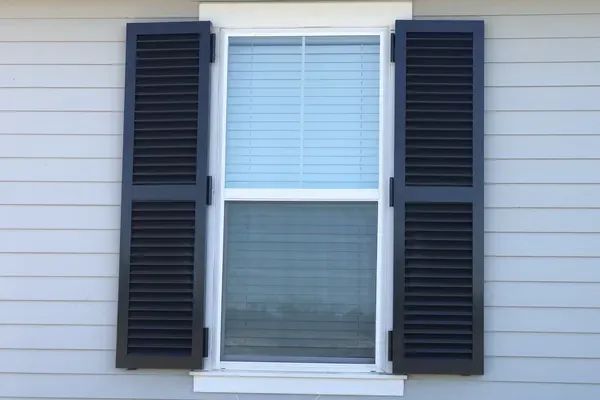
Two decorative panels on either side of the window that swing closed and latch. They look like traditional shutters, so they suit homes where appearance or HOA rules matter. Closing them is quick, though upper-floor windows may still need a ladder.
Want protection you'll also use on ordinary days, for shade, privacy and keeping bugs off the patio? Motorized screens, including hurricane-rated versions, are worth comparing too.
First, check what you already have
Bay County's code map marks land within a mile of the water as a wind-borne debris region, and homes permitted there in recent years needed protected openings. So a newer home near the water may already have impact-rated windows or shutters, and you may only need protection for a few openings, like an older slider, a garage door or a lanai. Check your permit records before you price a whole house.
What changes your price
Number and size of openings. Prices are per square foot, so wide sliding doors and big picture windows cost much more than standard windows.
Shutter type. Per square foot, the most expensive type here costs about seven times as much as the least expensive.
Second-story windows. Harder access means more labor.
Where your house sits. Homes in the wind-borne debris region need products rated for flying debris, not just wind.
Permits. Permanent shutters usually need a permit and proof the product meets the Florida Building Code. Ask whether the permit is included in your quote.
Will shutters lower my insurance?
They can. Florida law requires insurers to give you notice of the wind mitigation discounts they offer, and opening protection is one of the features that counts. You claim it with a wind mitigation inspection, which produces a standard form (OIR-B1-1802) for your agent.
Two things matter more than the shutter style. On that form, the opening-protection credits require every glass opening to be impact-rated or protected by an approved product, and the highest credit also covers solid doors and the garage door. So skipping one slider can cost you the discount. And the size of the discount depends on your insurer, so ask your agent for their credit list before you buy.
Help paying for it
My Safe Florida Home is a state program run by the Department of Financial Services. It offers a free wind mitigation inspection and, for eligible homeowners, a matching grant of up to $10,000: the state pays $2 for every $1 you spend, by reimbursement, and you need grant approval before work starts. To qualify for a grant, the home must be site-built, owner-occupied and homesteaded, insured for $700,000 or less, and permitted before January 1, 2008. Second homes and rental properties don't qualify.
Two cautions. Funding is limited and subject to the Legislature, and applications open in phases that prioritize homeowners by income and age, so some households will be reached later than others. And the program's list of grant-eligible opening protection names impact-resistant windows, doors, garage doors and skylights. It does not name shutters, so ask the program before you assume yours would qualify. Check mysafeflhome.com for the current status.
Is there a tax break? Florida's new home-hardening sales tax refund returns up to $500 of sales tax on impact-resistant windows, exterior doors and garage doors bought from July 1, 2026 through June 30, 2029, for eligible homes. The Department of Revenue's form lists those three products and does not list shutters. For income-tax treatment of home improvements, talk to a tax professional about your situation.
Questions to ask before you sign
Is this product approved for Florida, and what is its approval number?
Is it impact-rated for my location, and will it qualify for my insurance discount?
Will every opening be covered, including sliders and the garage door?
Who pulls the permit, and is it included in the price?
Will you show everyone in my household how to close them?
What's the warranty on the shutters and, if motorized, the motors?
One more tip: don't wait for a storm to show up in the forecast. Once one does, there isn't time to order, build and install shutters.
Brannan Aluminum has protected Gulf Coast homes since 1992, and we install all six types in this guide. That means we don't need to push you toward any one of them. We'll look at your house, talk about who's closing up when a storm comes, and help you pick what fits your family and your budget.
Frequently asked questions
How much do hurricane shutters cost in Northwest Florida?
Brannan's 2026 prices range from $16 to $115 per square foot, depending on the type. For a standard 3-by-5-foot window, that's about $240 to $360 for fabric shutters, $360 to $450 for storm panels, $750 to $900 for accordion shutters, $1,275 to $1,425 for motorized roll-downs and $1,560 to $1,725 for Bahama or colonial shutters.
What are the least expensive hurricane shutters?
Fabric shutters, at $16 to $24 per square foot, followed by storm panels at $24 to $30. Both are put up before a storm and stored afterward, so they take more work to use than permanent shutters.
Which hurricane shutters are easiest to close?
Motorized roll-downs: one button closes them, with no ladder or tools. Accordion shutters are the next easiest because they stay mounted beside each window and slide closed by hand.
Do hurricane shutters lower homeowners insurance in Florida?
They can. On the state's wind mitigation form, the opening-protection credits require every glass opening to be impact-rated or protected, and the top credit also covers solid doors and the garage door. Ask your agent for their discount list before you buy.
Do I need a permit for hurricane shutters?
Permanent shutters usually need a permit and proof the product meets the Florida Building Code. Your contractor should pull it, so ask whether it's included in your quote.
Can I get a grant for hurricane shutters?
Not clearly. The program's list of grant-eligible opening protection names impact-resistant windows, doors, garage doors and skylights, not shutters. Grants are up to $10,000 on a 2-for-1 match for eligible homesteaded homes permitted before 2008 and insured for $700,000 or less, and funding is limited and prioritized by income and age, so check mysafeflhome.com before you plan around it.
Sources
Associated Press via WBUR. Hundreds of thousands without power after Isaias slams the Florida Panhandle and Alabama. October 10, 2026. wbur.org
FOX 13. Hurricane Isaias updates: DeSantis addresses widespread power outages after landfall. October 10, 2026. fox13news.com
Florida Office of Insurance Regulation. Premium discounts for hurricane loss mitigation.
My Safe Florida Home. Frequently asked questions: eligibility, grant types and covered improvements. Modified May 15, 2026. mysafeflhome.com
Florida Legislature. Florida Statutes 215.5586, My Safe Florida Home Program. 2025 Florida Statutes. flsenate.gov
Florida Department of Revenue. Form DR-26HH, Home Hardening Products Sales Tax Refund. 2026. floridarevenue.com
