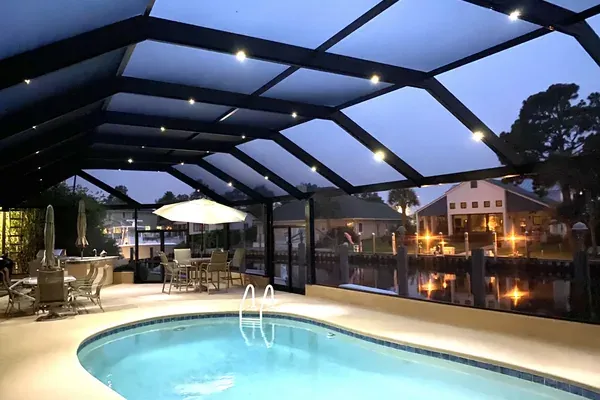
How Much Does a Pool Enclosure Cost on the Emerald Coast? A 2026 Guide for Local Families
On the Emerald Coast, a new pool screen enclosure generally costs somewhere between $8,000 for a small, simple cage and $50,000 or more for a large, custom or highly exposed coastal one. Most standard family pools fall around $12,000 to $30,000. The spread is real. It comes from your pool's size and shape, the roof, the wind engineering behind the design, the screen type, the condition of your pool deck and extras such as fans and lighting.
These are general 2026 estimates based on Florida and national cost data, not Brannan quotes, so treat them as a starting point. Bay County's code map shows ultimate design wind speeds of 130 to 140 mph, so ask any bidder what wind speed the enclosure is engineered for. A fair quote lists the square footage, roof style, screen type, number of doors, wind rating and who pulls the permit.
Typical 2026 estimates for a pool screen enclosure in Florida
Project | What it usually looks like | Typical estimate |
|---|---|---|
Small, simple enclosure | Compact pool, standard roof, standard screen | $8,000 – $15,000 |
Standard family pool | Mid-size pool with some deck space | $12,000 – $30,000 |
Large or custom | Bigger footprint, taller roof, upgraded screen | $30,000 – $50,000 |
Two-story, panoramic or exposed coastal | Tall roof line, wide view panels, heavier wind engineering | $40,000 – $70,000+ |
Rescreening an existing enclosure | Frame in good condition, screen worn or torn | $2,000 – $8,000 |
These are general estimates drawn from 2026 Florida and national cost guides. Coastal homes, taller roofs and stricter wind engineering push a project toward the top of each range. Use them to see the spread, then get written quotes for your own pool.
What you're actually paying for
Two enclosures can look almost identical from the street and be thousands of dollars apart. Here's where the money goes.
1. Size and shape
A cage that only covers the water costs less than one that also covers a sitting area. Shape matters too. A simple rectangular pool is easier to engineer and enclose than an irregular shape or one with an attached spa, which needs custom framing and more engineering work.
2. Roof
A screen roof is the most affordable option and still the most common. A solid polycarbonate roof blocks rain and afternoon sun, but it costs far more per square foot than screen and can add several thousand dollars to a project. Some homeowners mix the two, with a solid section over a seating area and screen over the water.
3. Wind engineering
Bay County's 2023 code map shows ultimate design wind speeds of 130 to 140 mph across the county, and it maps land within one mile of the mean high-water line as a wind-borne debris region. Ask what wind speed your enclosure is engineered for and whether signed and sealed engineering drawings come with the permit. If a bidder can't answer, that tells you something.
4. Screen type
Standard pool and patio screen is 18x14 mesh. Saint-Gobain ADFORS makes a finer 20x20 small-insect screen designed to stop no-see-ums, gnats and sand flies. Sources differ on airflow: ADFORS says its small-insect screen doesn't obstruct airflow, while a review in Cutis says finer mesh can restrict it. Ask to see a sample, and consider using the fine mesh only on the walls or roof sections where you need it most.
5. Your deck
The enclosure is anchored to your pool deck. If the concrete needs repair, leveling or reinforcement before new posts can go in, expect that work to add to the price.
6. The extras
Ceiling fans, lighting and outlets all add cost, and electrical work needs a licensed electrician. National cost data puts outdoor lighting at roughly $625 per fixture installed. None of it is required, so decide which extras your family will actually use.
Will it survive the next big storm?
After this month, it's probably your first question. Hurricane Isaias came ashore near Destin on October 9 as a Category 2 storm with 105 mph winds, flooding roads in Destin and leaving debris across streets in Pensacola. And if you lived here in 2018, you remember Michael, which came ashore near Mexico Beach with 160 mph winds, according to NOAA's final analysis. That is above the 130 to 140 mph design speeds on Bay County's map today.
The honest answer: no screen enclosure is storm-proof. What you can control is whether yours is engineered for your address and whether you know what to do when a storm is coming. Before you sign, ask:
What wind speed is this enclosure engineered for?
Will I get signed and sealed engineering drawings with the permit?
Are there screen panels designed to be removed or cut before a big storm, and who will do it?
That last question matters more than most people realize. Florida's screen enclosure rule, 61G20-1.002, lets engineers design the frame on the assumption that designated screen panels are removed, retracted or cut before the wind arrives. Panels designated to be cut must be completely cut when winds are forecast to exceed 75 mph, and the contractor must give the owner and the building department written notice that the owner has to do it. The rule also says doing this can't require a ladder or scaffolding. So ask who in your household will do it, and where the labeled panels are.
Call your insurance agent before you build
Many families find out too late that standard Florida homeowners insurance generally doesn't cover hurricane damage to a pool cage. Coverage usually comes from a separate screen enclosure endorsement, which Kin Insurance says is typically available in $5,000 increments up to $50,000, and your hurricane deductible still applies when you use it. Slide Insurance notes that some companies cover only the frame and not the screens, and others offer no coverage at all. A five-minute call to your agent before you build tells you what it costs to protect what you're about to buy.
Your enclosure and Florida's pool safety law
If grandkids or young visitors come over, this part matters. Florida's Residential Swimming Pool Safety Act requires a new residential pool to have at least one of five safety features before it can pass final inspection:
An enclosure that meets the state's barrier requirements
An approved safety pool cover
Exit alarms on doors and windows from the home
Self-closing, self-latching devices on every door from the home to the pool
A certified pool alarm
A screen enclosure can be part of the answer. The state's screen enclosure rule says a design that serves as the required barrier has to keep that barrier in place when panels are removed or cut. Ask your contractor and your building department how your enclosure and its doors will meet the requirement, and where the latches will go.
When an enclosure isn't worth it
Not every pool needs a cage. If your pool has no trees nearby, you rarely swim at dusk, or the open view is the whole point of your backyard, the money may be better spent elsewhere.
And if what you really want is a bug-free place to sit, not a cage over the whole pool, there are lighter options. A screened-in lanai or a motorized screen on a covered patio can give you that without covering the pool.
What it costs over the years
A well-built aluminum frame can last many years with regular care, but the screen wears out sooner. Plan on replacing the screen roughly every 10 to 15 years, and sooner on the coast, where salt spray and strong sun age materials faster. Plan on at least one rescreening during the life of the enclosure. Rescreening an enclosure with a sound frame generally runs about $2,000 to $8,000, depending on its size and condition.
How to get a quote you can trust
Before you get quotes, check your HOA rules. Some communities don't allow aluminum structures at all, and it's better to know before anyone measures your yard.
A good quote should list the square footage, roof style, screen type, number of doors, wind rating and who pulls the permit. If any of those are missing, ask. In Bay County, building permit applications go through the county's online permitting portal and fees are based on the value of the work, so ask whether the permit and its fee are included in the price.
Brannan Aluminum has served Panhandle homeowners since 1992. If you'd like a second set of eyes on a quote you already have, we're happy to walk through it with you.
Frequently asked questions
How much does a pool enclosure cost on the Emerald Coast?
In 2026, a new pool screen enclosure in Florida generally costs about $8,000 to $50,000 or more, and most standard family pools fall around $12,000 to $30,000. Coastal homes, taller roofs and stricter wind engineering push the price higher. Your pool's size, roof style, wind engineering, screen type and deck condition decide where you land.
Do I need a permit for a pool enclosure in Bay County?
Yes. A new pool enclosure needs a building permit, and Florida's screen enclosure rule expects engineering documents with the permit application. In Bay County, applications go through the county's online permitting portal and permit fees are based on the value of the work.
Will a pool cage survive a hurricane?
No enclosure is guaranteed to survive a storm stronger than its design. Hurricane Michael came ashore in 2018 with 160 mph winds, above the 130 to 140 mph design speeds on Bay County's current map, so ask for the wind rating and engineering drawings before you sign. If your enclosure is designed with panels to be cut or removed, the state rule makes that your job when winds are forecast above 75 mph.
Does homeowners insurance cover a pool enclosure?
Often not for hurricane damage. Coverage usually comes from a separate screen enclosure endorsement, and your hurricane deductible still applies. Check with your agent before you build.
What screen keeps out no-see-ums?
A finer small-insect mesh, commonly 20x20, is made for no-see-ums, gnats and sand flies, while standard 18x14 pool screen is built for general insect protection and strength. Sources differ on how much the finer mesh reduces airflow, so ask to see a sample.
How long does a pool enclosure last?
A well-built aluminum frame can last many years with regular care, but plan on replacing the screen roughly every 10 to 15 years, sooner with heavy salt air or sun. Rescreening an enclosure with a sound frame generally costs about $2,000 to $8,000.
Next in Series: How Much Does Crimsafe Cost in Florida? A 2026 Guide for Local Families
Sources
Angi. How Much Does a Pool Enclosure Cost to Install? [2026 Data]. Updated September 1, 2026.
Breaking AC News. What Is the Average Pool Enclosure Cost in Florida? May 8, 2026.
Bay County Building Safety Division. Building permit fee schedule, 2023-2024.
Bay County Building Safety Division. Frequently asked questions: online permitting portal.
National Oceanic and Atmospheric Administration. Hurricane Michael upgraded to a Category 5 at time of U.S. landfall. April 2019. noaa.gov
Associated Press via WBUR. Hundreds of thousands without power after Isaias slams the Florida Panhandle and Alabama. October 10, 2026. wbur.org
FOX 13. Hurricane Isaias updates: DeSantis addresses widespread power outages after landfall. October 10, 2026. fox13news.com
Florida Building Commission. Rule 61G20-1.002, Alternative Design Method for Screen Enclosures (Commission copy). August 2015 meeting. floridabuilding.org
Florida Legislature. Florida Statutes 515.27, Residential swimming pool safety feature options. 2025 Florida Statutes. flsenate.gov
Slide Insurance. The Slide Guide to Screened Enclosures and Pool Cages.
WGCU News. High pollen levels, especially from trees, reported across state. January 12, 2026.
Saint-Gobain ADFORS. Pool and patio screen selection: Pool & Patio 18x14 and Small Insect 20x20.
Cutis (MDedge). Dermoscopic documentation of a no-see-um bite. Cutis, vol. 116.
