Shutters, Panels, Fabric or Screens: What Counts as Hurricane Protection in Florida?
Shutters, Panels, Fabric or Screens: What Counts as Hurricane Protection in Florida?
Florida does not treat every window covering the same. In a wind-borne debris region, the building code asks glazed openings to be impact resistant or covered by protection that passes a large-missile test, and each shutter, panel, fabric or screen product earns its place through a state approval, not through a brochure.
This guide explains what the code requires, which product types exist, and how to tell whether a product counts.
Quick answer
What counts as hurricane protection for windows in Florida?
In a wind-borne debris region, the Florida Building Code requires glazed openings to be impact resistant or protected by a covering that meets the Large Missile Test of ASTM E 1996 and ASTM E 1886, with other listed test standards for garage doors. Impact-rated windows and doors, and shutters, panels and fabric products that carry a Florida Product Approval, are the usual ways to comply. Each approved product must be installed exactly as its approval documents require. The code also contains an exception for houses with a mean roof height of 33 feet or less: wood structural panels at least 7/16 inch thick, precut, predrilled and secured to permanently installed hardware, which Bay County documents on its Form B23. Hurricane screens count only if the specific product has a current Florida approval for the use. Which type fits your home depends on your openings, your budget, how you will deploy it and any association rules.
What does the Florida Building Code require for windows?
The code's protection-of-openings sections, cited as R301.2.1.2 for houses and 1609.1.2 for other buildings, require glazed openings in a wind-borne debris region to be protected from wind-borne debris. Protection must meet the Large Missile Test of ASTM E 1996 and ASTM E 1886, and the code names other test standards for garage doors and for particular products.
Whether your lot sits inside a wind-borne debris region depends on the wind map and, for older homes, on the code that applied when the home was permitted. This guide covers what counts as protection once a home needs it. It does not decide whether your home does.
Which types of hurricane protection exist?
The table lists the main types. The approval examples are records on the Florida Building Commission's website, shown to illustrate how approvals read. They come from one manufacturer because those were the records we reviewed, and they are not a ranking or a recommendation.
| Type | How it works | What the record shows |
|---|---|---|
| Impact-resistant windows and doors | The glazing itself resists large-missile impact, so no covering is needed. | The code allows glazed openings to be impact resistant on their own. |
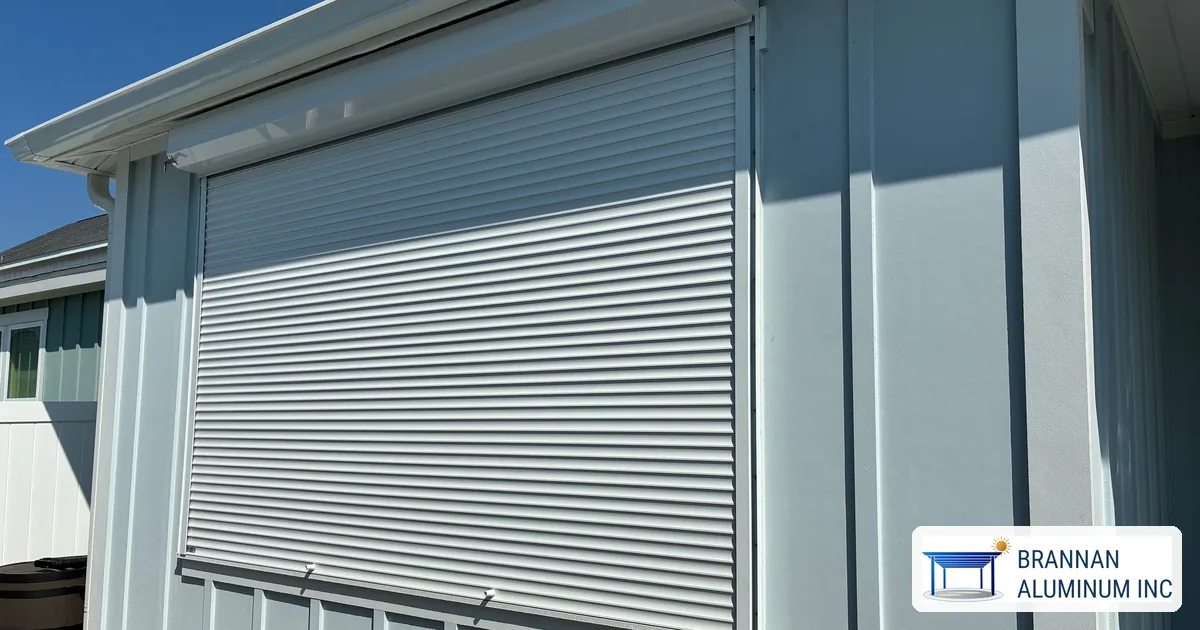
| Roll-down shutters | An aluminum curtain on a track, operated by hand or motor. | FL14235.2, Eyewall Armor 44 mm Aluminum Roll-Up Shutter, evaluated June 2020 to the Florida Building Code, Seventh Edition (2020). |
| Accordion shutters | Panels that fold along a track beside the opening. | FL13757, 6.8 Accordion Shutter, large-missile-impact resistant, evaluated July 2023 to the Eighth Edition (2023). |
| Fabric shutters | Custom-cut, numbered fabric panels fastened to anchors or trim. | FL17003.1, Eyewall Armor Fabric Shutter, evaluation report dated June 9, 2020. |
| Storm panels | Removable metal or polycarbonate panels installed before a storm. | Florida's 2024 homeowners' association law lists polycarbonate panels as hurricane protection. Each panel product still needs its own approval. |
| Hurricane screens | Engineered screens, fixed or motorized, that cover the opening. | They count only if the specific product holds a current Florida approval for the use. Check the number. |
| Wood structural panels | Precut, predrilled plywood or similar panels on permanent anchors. | A code exception, not an approved product. Bay County documents it on Form B23. |
What does "approved" mean for a shutter or panel?
Each approved product has an evaluation report and engineering drawings on file with the Florida Building Commission. The report for the fabric shutter above, for example, states that the product was evaluated for compliance with the code edition named in the report, that it must be installed in strict compliance with the evaluation documents, and that re-evaluation is required after pertinent changes to the code.
That last point matters when you shop. An approval number tells you the product passed review under a particular edition of the code. It does not tell you the installer followed the drawings, and it does not tell you the approval is current. Both can be checked.
What else decides which type fits your home?
- Your openings. Approvals publish span and anchor limits, so a product that works on a window may not cover a wide sliding door.
- How you will deploy it. Roll-down and motorized systems are operated from the opening by crank or motor. Removable panels and fabric need hands and time before every storm.
- Where you store it. Removable products need dry storage between storms.
- Association rules. A 2024 Florida law requires homeowners' associations to adopt hurricane protection specifications, which can include color and style.
How do you tell whether a product counts?
- Get the product name, manufacturer and Florida Product Approval number from the contractor, in writing, for each type of opening.
- Look the number up in the Florida Building Commission's Product Approval search and confirm the status is Approved.
- Check the evaluation report for the code edition and for any limits on span, anchors or use.
- Look for a permanent label on the installed product and photograph it.
What does this guide not settle?
- Which type is best. We do not rank products. The right choice depends on your openings, budget and routine.
- Whether your home needs protection. That turns on the wind map and the code in force when the home was permitted.
- The current wording of every code section. We cite the code's protection-of-openings requirement as it appears in the 2007 supplement and on Bay County's 2023-code form. Check the edition that applies to your permit.
- Whether a given approval is still current. The examples above are the revisions we reviewed. Look up the number for your own product.
- How insurers treat each type. That is a question for your insurer.
What should you do this week?
- List the openings on your home: windows, sliding doors, entry doors, garage door.
- Write down what, if anything, covers each one today.
- For anything you plan to buy, get the approval number first.
Sources
- Florida Building Code, 2007 Supplement, Chapter 16 and Residential R301.2.1.2 (protection of openings). floridabuilding.org
- Bay County Community Development Department. Form B23, Wind-Borne Debris Protection Affidavit and Notice (2023 Florida Building Code, Eighth Edition). baycountyfl.gov
- Engineering Express for Town and Country Industries. Product Evaluation Report, FL17003.1-R8, Eyewall Armor Fabric Shutter. June 9, 2020. floridabuilding.org
- Engineering Express for Town and Country Industries. Product Evaluation Report, Eyewall Armor 44 mm Aluminum Roll-Up Shutter (FL14235 R7). June 9, 2020. floridabuilding.org
- Engineering Express for Town & Country Industries. Product Evaluation Report, 6.8 Accordion Shutter (FL13757 R10). July 27, 2023. floridabuilding.org
- Florida Legislature. CS/HB 293, Hurricane Protections for Homeowners' Associations (Chapter 2024-205, Laws of Florida). 2024. flsenate.gov
